🔠 Uppercase and Lowercase Matching Worksheet
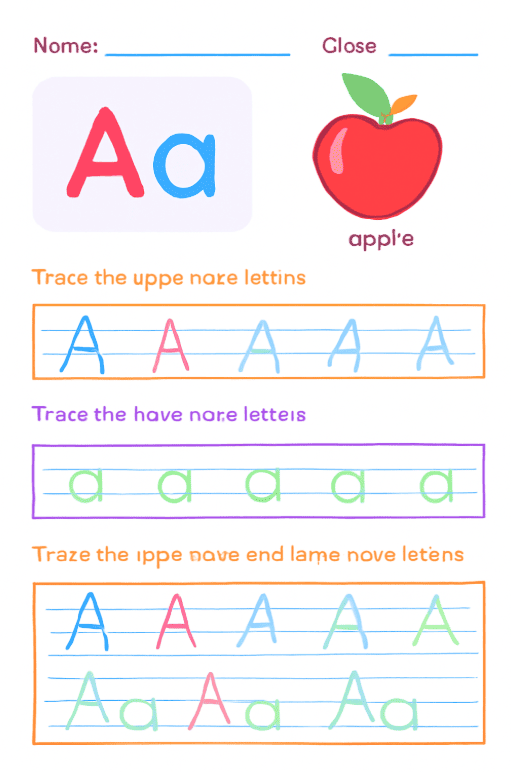
| 🎯 Learning Objective | Recognize that each uppercase letter has a corresponding lowercase form, and correctly pair them |
| 📊 Difficulty | Intermediate — assumes some individual familiarity with both letter forms already |
| 👶 Best For | Ages 4–6, kindergarten |
| ⏱️ Estimated Time | 10–15 minutes |
| 🖊️ Materials Needed | Printed worksheet, pencil or crayon |
👩🏫 Teacher Instructions
In the Classroom
This skill is genuinely different from recognizing either letter form alone — a student can know uppercase A and lowercase a individually without automatically knowing they represent the same letter. Some pairs are visually obvious (C/c, O/o, S/s share the same basic shape at different sizes), while others look completely different (A/a, G/g, R/r) and need more direct teaching. Group practice around the harder, visually dissimilar pairs specifically, rather than treating all 26 pairs as equally difficult.
👨👩👧 Parent Instructions
At Home
If your child already knows uppercase and lowercase letters separately (from our tracing and lowercase tracing worksheets), this is a natural next step that connects the two. Point out the visually similar pairs first (C/c, O/o) to build early confidence before tackling the pairs that look completely different from each other.
✅ What Successful Completion Looks Like
Not a Traditional "Answer Key"
The correct pairing is simply each letter matched to its own uppercase/lowercase counterpart (A-a, B-b, and so on through the alphabet) — a fixed, universal answer that doesn't vary by print. Watch specifically for errors on the visually dissimilar pairs (A/a, G/g, Q/q, R/r) rather than treating any single mistake as concerning; these are the pairs that take the longest to become automatic.