🔡 Lowercase Letter Tracing Worksheet
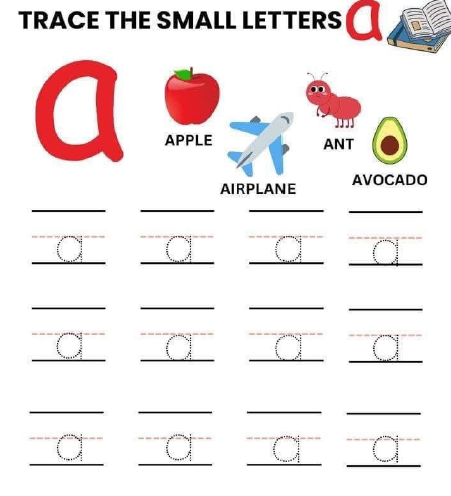
| 🎯 Learning Objective | Practice forming lowercase letters, which have different shapes and stroke patterns than their uppercase counterparts |
| 📊 Difficulty | Beginner-plus — comes after uppercase tracing is fairly comfortable |
| 👶 Best For | Ages 4–6, kindergarten |
| ⏱️ Estimated Time | 5–10 minutes per session |
| 🖊️ Materials Needed | Printed worksheet, pencil or crayon |
👩🏫 Teacher Instructions
In the Classroom
Lowercase letters are genuinely harder than uppercase for many children — several have curves and tails (like a, g, and y) that uppercase versions don't, and some pairs are easy to confuse in shape (b and d, p and q). Introduce these commonly-confused pairs in separate sessions rather than side by side, and point out explicitly which letters sit on the line, which dip below it, and which rise above it — that positional awareness is a real part of legible lowercase writing.
👨👩👧 Parent Instructions
At Home
If your child already traces uppercase letters comfortably, lowercase is the natural next step — but expect it to feel harder again for a little while, since the shapes are genuinely less familiar. Naming the letter as it's traced still helps, and it's worth connecting this practice to our alphabet tracing worksheet if uppercase formation still needs some reinforcement too.
✅ What Successful Completion Looks Like
Not a Traditional "Answer Key"
As a handwriting sheet, there's no single correct answer to check against. Look instead for letters that generally sit correctly relative to the line (not floating above it or sinking too far below), reasonably consistent sizing across repetitions, and a comfortable, unhurried pencil grip. Mixing up b/d or p/q occasionally at this age is common and typically fades with continued practice, not correction pressure.