✂️ Basic Cutting Skills Worksheet
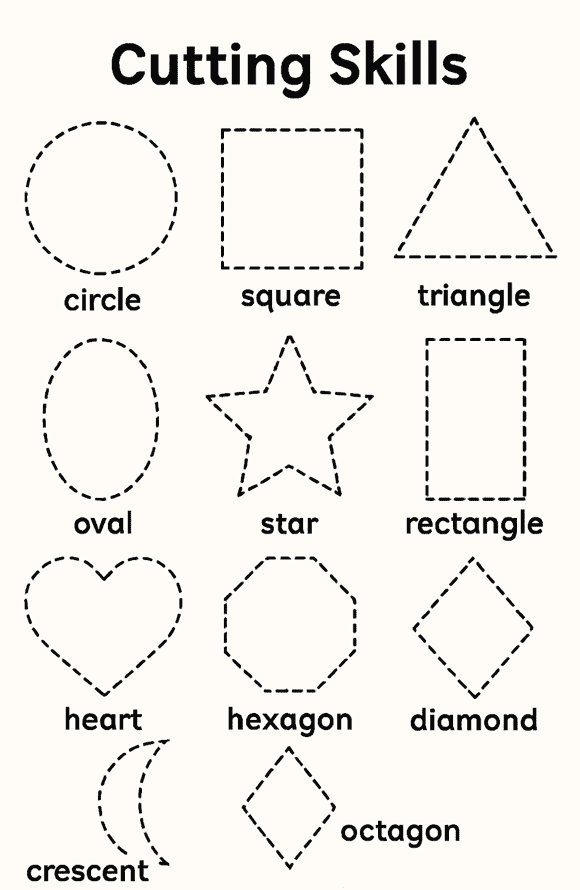
| 🎯 Learning Objective | Build the hand strength, bilateral coordination, and scissor control that support later handwriting and self-care skills |
| 📊 Difficulty | Beginner — first exposure to scissors is fine |
| 👶 Best For | Ages 3–4, preschool |
| ⏱️ Estimated Time | 10 minutes, with adult supervision throughout |
| 🖊️ Materials Needed | Printed worksheet, child-safe blunt-tip scissors |
⚠️ Safety First
Always use child-safe, blunt-tip scissors, and supervise cutting activities directly — don't leave a young child unsupervised with scissors, even safety ones. If your child isn't ready to hold scissors correctly yet, that's completely fine; simply tearing paper along a line is a genuine, valid alternative that builds similar hand skills.
👩🏫 Teacher Instructions
In the Classroom
Demonstrate the correct scissor grip first — thumb up, fingers curled, and the paper turning into the scissors rather than the scissors chasing the line. Start with short, straight snips rather than expecting a single continuous cut along a long line; many children need to build up to continuous cutting motion gradually. Praise the attempt and the grip, not just a perfectly straight line — precision comes later.
👨👩👧 Parent Instructions
At Home
If scissors feel frustrating at first, that's very normal — this is often a child's first time coordinating two hands doing two different jobs at once (one holding, one cutting). Short sessions work much better than one long one; a few minutes of genuine focus beats ten minutes of a tired, frustrated child. This skill directly supports the handwriting practice in our alphabet tracing worksheet, since both rely on similar hand strength and control.
✅ What Successful Completion Looks Like
Not a Traditional "Answer Key"
Since this is a motor-skills practice sheet, there's no right or wrong answer to check — instead, look for a correct scissor grip (thumb up, fingers through the holes properly) and reasonable control staying near the line, even if the cut isn't perfectly straight. A jagged or imprecise cut from a child who's holding the scissors correctly and trying to follow the line is genuine, real progress at this stage.