🖍️ Color Word Matching Worksheet: Objects by Color
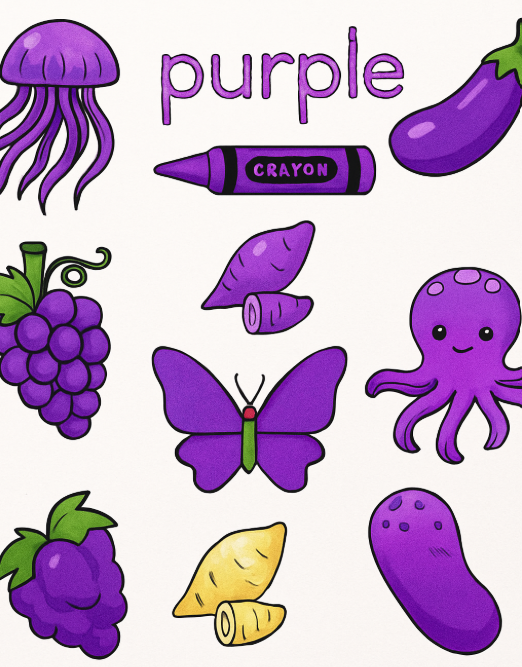
| 🎯 Learning Objective | Group six familiar real-world objects that share one color, and trace the color word itself — connecting the category concept to its written name |
| 📊 Difficulty | Beginner to intermediate — the color word trace is longer than a single letter but still a fixed, repeated pattern |
| 👶 Best For | Ages 3–5, preschool and pre-kindergarten |
| ⏱️ Estimated Time | 5 minutes per page, 9 pages total (one per color) |
| 🖊️ Materials Needed | Printed pages, crayons matching each page's color, pencil |
👩🏫 Teacher Instructions
In the Classroom
Each page in this set groups six everyday objects that all share one color — for example, a strawberry, a heart, and a tomato on the "red" page — rather than coloring a single item. This builds the category concept behind a color word (many different things can be "red") alongside tracing the word itself. Have students name each object before coloring it, reinforcing that the shared color, not the object type, is the point of the page.
👨👩👧 Parent Instructions
At Home
This differs from our colouring sheets worksheet, which focuses on general pencil control across mixed subjects — here, every object on a page is intentionally the same color, so ask your child to predict the color before they start, based on the objects shown (a strawberry and a heart are a strong hint for "red"). This turns coloring into a quick color-vocabulary check.
✅ What Successful Completion Looks Like
Not a Traditional "Answer Key"
Each page has one intended color for all six objects, matching the traced word at the top — there's no ambiguity in which crayon to use. Watch for a child coloring objects in their "realistic" color instead of the page's target color (coloring the grapes purple on the "green" page, for instance) — a gentle reminder that this page is about practicing one specific color, not object-accurate coloring, keeps the exercise on track.